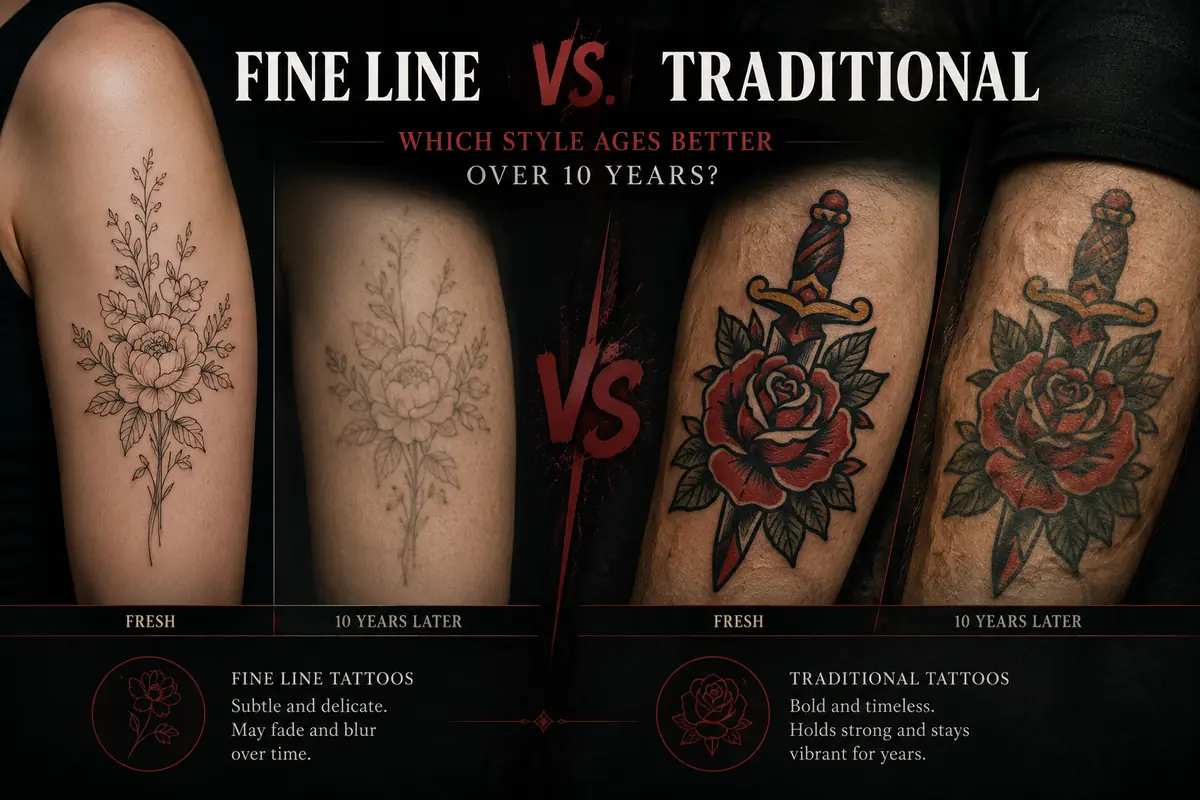
The tattoo world is split in an interesting way right now. On one side, American Traditional is roaring back with heavy black outlines and saturated color. On the other, Fine Line keeps winning people over with delicate single-needle details, tiny astrology charts, and subtle micro-portraits.
When scrolling through freshly inked photos on social media, both styles can look beautiful. But a tattoo is not a static canvas. It lives in skin that ages, stretches, tans, dries out, and renews itself every day.
If you are trying to decide between these two starkly different aesthetics, you must look beyond the immediate post-session photograph. How will these styles hold up when your skin undergoes a decade of cellular regeneration and sun exposure? Let’s analyze the 10-year outlook of Fine Line versus Traditional body art.
The Biological Reality of Aging Ink
To understand why styles age differently, we must examine what happens to ink beneath the surface of the skin over time. When a tattoo needle deposits pigment into the dermis, your body's immune system recognizes the ink particles as foreign invaders.
Macrophage cells (white blood cells) are dispatched to consume the ink. Because the pigment particles are too large for the cells to destroy, the macrophages essentially trap the ink in place, suspending it within the dermal layer.
However, over a span of five, ten, or twenty years, those original cells die and are replaced by new ones. When a cell dies, it drops its tiny package of ink, which is then picked up by a neighboring cell. During this generational hand-off, the ink particles naturally shift, spread, and settle slightly deeper into the skin. This natural biological process is called ink spreading or blurring.
Traditional Tattoos: Built Like a Brick Wall
There is an old, unwavering adage in the tattooing community: "Bold will hold." This philosophy is the foundation of American Traditional and Neo-Traditional design work.
| Aging factor | American Traditional | Fine Line | What this means in real life |
|---|---|---|---|
| Line saturation | Heavy black outlines, often 9-14 round liners | Single-needle or very small liner groupings | Traditional designs usually stay readable from farther away. |
| Contrast retention | Strong black, bold color, clear negative space | Soft grey, thin details, low ink volume | Fine line pieces need better sun care and may need touch-ups sooner. |
| Detail spacing | Built with room for natural ink spread | Details can sit very close together | Micro details may merge if the design is too small. |
| 10-year maintenance | Often minimal if protected from sun | Touch-ups are common every few years | The right choice depends on whether you prefer low maintenance or subtlety. |
Why Traditional Ages Exceptionally Well
Traditional tattoos use thick needle configurations (typically 9 to 14 Round Liners) packed with dense carbon black pigment deep into the optimal zone of the dermis. Because the lines are already intentionally thick, the microscopic ink spreading that happens over a decade simply blends into the existing structure.
The heavy contrast between deep black, vibrant primary colors (reds, yellows, greens), and negative space means that even when the tattoo fades by 15% over ten years, the structural silhouette often stays legible from across a room. A traditional lion, skull, or dagger should still read clearly in 2036.
The Downside After 10 Years
The primary issue with aging Traditional ink is that thin gaps of negative space within intricate parts of the design may eventually close up due to lines expanding toward one another. This is why experienced traditional artists leave ample space between parallel lines.
Fine Line Tattoos: The Fragile Masterpiece
Fine Line and Micro-tattoos can look beautifully elegant when fresh. They feel modern, quiet, and easy to conceal. They do, however, fight an uphill battle against human biology.
Why Fine Line is Prone to Fading
Fine line work uses single-needle arrangements (1RL or 3RL) to create lines that are a fraction of a millimeter wide. Because the artist is working with such a small amount of pigment, there is very little room for error or cellular movement.
Over a decade, as macrophage cells cycle and shift, those micro-fine lines inevitably begin to blur. What was once a crisp, microscopic row of Roman numerals can easily soften into a faint, slightly grey smudge. If the lines are placed too close together—such as the delicate petals of a micro-rose—the expanding ink can cause the individual elements to merge, losing the structural definition that made the tattoo beautiful in the first place.
The "Blowout" and Depth Risk
Fine line work requires surgical precision. If the artist presses a fraction of a millimeter too deep, the thin line hits the subcutaneous fat layer and "blows out," creating a blurry, blue-tinted halo effect. If they tattoo too shallowly to avoid this, the ink sits in the upper epidermis and washes away entirely during the natural shedding process within the first year.
Head-to-Head: The 10-Year Breakdown
1. Legibility and Contrast
- Traditional: Usually wins on readability. The high-contrast framework helps the design read clearly through aging, changing skin texture, and minor sun damage.
- Fine Line: Requires immaculate care. Without solid black foundations, fine details rely heavily on subtle grey washes which fade the fastest under UV exposure.
2. The Touch-Up Factor
- Traditional: Rarely requires a touch-up within the first 10 to 15 years unless subjected to extreme sun abuse.
- Fine Line: Expect to visit your artist every 3 to 5 years to re-saturate fading lines and re-define lost details.
3. Versatility and Evolution
- Traditional: Harder to cover up or laser remove due to the massive volume of dense black ink packed into the skin.
- Fine Line: More forgiving if your taste changes. Because the ink volume is low, a fine-line piece is often easier to laser or cover than a dense traditional tattoo.
How to Make Fine Line Tattoos Last
Choosing a Fine Line tattoo does not mean you are signing up for a blurry smudge in ten years. You can extend its lifespan by following three strict rules:
- Choose the Right Location: Put fine line work on flat, low-friction areas that don't stretch drastically, such as specialized areas of the forearm, bicep, or calf. Avoid fingers, hands, feet, and ribs where skin shedding and friction are accelerated.
- Obsessive Sun Protection: UV rays break down ink particles like a laser cutter. Apply SPF 50 sunscreen over your healed tattoo every single day without exception.
- Go Slightly Larger: Giving a fine-line design a bit more breathing room allows the ink to naturally expand over ten years without overlapping neighboring details.
Visualize the Lifespan Before You Choose
Whether you prefer the heavy, timeless armor of American Traditional or the quieter elegance of Fine Line artistry, the biggest mistake is choosing scale without thinking about your body. Placement matters too: if you are still deciding where to put your first piece, start with our tattoo pain map for first-timers before you commit to a spot.
Once you have a direction, bring it into a real-world conversation. The guide on talking to a tattoo artist about references and pricing explains how to show AI concepts without asking an artist to copy someone else's work.
Style longevity also depends on care. If you are leaning toward fine line, read the tattoo aftercare timeline before your appointment, because sun exposure and friction are where delicate work often loses the most.
To find the right balance between bold longevity and delicate detail, explore our AI Tattoo Generator. Test the same concept in both a bold "Traditional" style and a delicate "Fine Line" variant, then use our simulator to preview them directly on your skin. Seeing the structure clearly beforehand helps you design a piece that looks good on day one and still makes sense years later.
Preview the idea before you book ink
Use AI Tattoo Generator to turn your concept into a visual reference, then test placement on your own photo before talking with an artist.
Create Tattoo